
What Is a Content Roadmap? A Complete Guide With Examples

A content roadmap is a strategic planning framework used to organize, prioritize, and schedule content marketing initiatives around business goals, audience needs, production timelines, and measurable KPIs. It translates high-level marketing objectives into actionable editorial projects, ensuring every piece of published content serves a direct business purpose.
In this guide, you will learn what a content roadmap is, how it differs from a content strategy and editorial calendar, how to build one step-by-step using a prioritization framework, and how to track performance using practical examples and copyable templates.
What Is a Content Roadmap?
A content roadmap is a high-level operational document that maps out planned content projects across strategic themes, target audiences, search queries, and specific time horizons. It acts as the bridge between why you create content (strategy) and when you publish it (calendar).
| Attribute | Details |
| Primary Objective | Connect business objectives to prioritized content production. |
| Typical Planning Horizon | 3 to 12 months (reviewed monthly or quarterly). |
| Primary Users | Content strategists, SEO leads, marketing managers, and CMOs. |
| Core Asset Types Covered | Pillar pages, articles, case studies, videos, and refreshes. |
Content marketing and SEO teams use a content roadmap to:
- Organize individual content assets around strategic themes and content clusters.
- Assign production priorities based on organic search demand and commercial value.
- Balance top-of-funnel educational resources with bottom-of-funnel conversion assets.
- Allocate writer, designer, and subject-matter expert resources effectively over time.
A typical content roadmap spans 3 to 12 months. Unlike tactical task boards, it stays focused on outcomes, audience segments, and search intent rather than day-to-day drafting mechanics.
Key Components of a Content Roadmap
Every functional content planning roadmap contains four operational pillars:
- Strategic Context: The business objective, buyer persona, and core content pillar being targeted.
- Execution Details: The proposed topic, primary and secondary keywords, search intent, and delivery format.
- Operational Mechanics: The project owner, production status, target delivery milestone, and dependencies.
- Performance Measurement: The target funnel stage, primary KPI, and post-publish performance review date.
Why Is a Content Roadmap Important?
Without a roadmap, content teams often default to reactive publishing—producing posts simply to fulfill an arbitrary editorial quota. A structured content roadmap eliminates random acts of content and provides clear business advantages:
- Aligns Content With Business Goals: Ensures every planned article, case study, or landing page directly contributes to pipeline growth, sign-ups, or retention.
- Prioritizes High-Value Topics: Helps teams evaluate search volume, business intent, and implementation effort so they can target high-ROI opportunities first.
- Prevents Disconnected Content: Connects standalone articles into organized topic clusters, strengthening topical authority across your primary service or product categories.
- Improves Team Coordination: Keeps strategists, freelance writers, designers, subject-matter experts (SMEs), and editors working toward the same milestones without bottlenecks.
- Identifies Content Gaps: Pinpoints underserved stages of the buyer journey, missing comparison queries, and keyword opportunities your competitors dominate.
- Makes Content Performance Measurable: Sets explicit KPIs for every asset before drafting begins, making post-publish analysis objective rather than subjective.
- Creates a Repeatable Planning Process: Removes guesswork from editorial meetings by establishing an agreed-upon system for reviewing, adding, and deprioritizing topics.
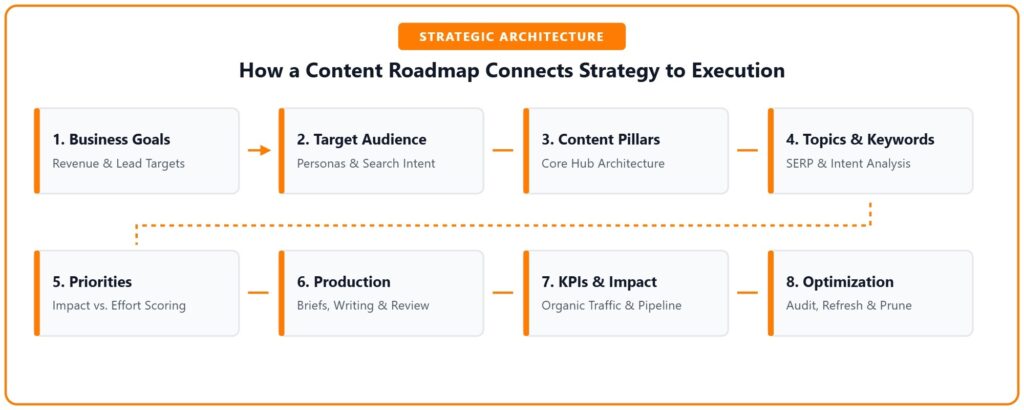
What Should a Content Roadmap Include?
A comprehensive content roadmap balances strategic context with execution tracking. The table below details the 14 core components needed to manage production effectively:
| Component | Definition | Why It Matters |
| 1. Business Goal | The commercial objective (e.g., pipeline, trials, brand reach). | Connects marketing spend to direct business outcomes. |
| 2. Target Audience | The primary persona or ICP (Ideal Customer Profile). | Ensures appropriate tone, technical depth, and use-case alignment. |
| 3. Content Pillar | The parent category or core thematic bucket. | Organizes assets into logical topical architecture. |
| 4. Topic | The working title or working concept of the piece. | Sets the clear focus and operational scope for the writer. |
| 5. Keywords | Primary target keyword and secondary supporting keywords. | Directs on-page optimization and semantic coverage. |
| 6. Search Intent | Informational, Commercial, Transactional, or Navigational. | Dictates the structure and depth required to satisfy search engines. |
| 7. Content Format | Long-form guide, comparison table, template, case study, etc. | Determines layout requirements and design assets needed. |
| 8. Funnel Stage | Top-of-Funnel (TOFU), Middle (MOFU), or Bottom-of-Funnel (BOFU). | Balances brand discovery content with direct-conversion assets. |
| 9. Priority | Tier 1 (High), Tier 2 (Medium), or Tier 3 (Low). | Dictates production order based on revenue potential and effort. |
| 10. Content Owner | The specific strategist, writer, or editor responsible. | Enforces accountability across multi-member teams. |
| 11. Timeline | Target draft, review, and publication milestones. | Prevents pipeline delays and keeps quarterly goals on schedule. |
| 12. Primary KPI | The main success metric (e.g., Organic Traffic, MQLs, Sign-ups). | Establishes the exact benchmark for evaluating success. |
| 13. Status | Backlog, Briefing, In Progress, In Review, or Published. | Provides real-time visibility into editorial pipeline health. |
| 14. Review Date | Scheduled post-publish audit date (typically 90–180 days). | Prompts timely content refreshes and updates. |
Content Roadmap vs. Content Strategy vs. Content Calendar
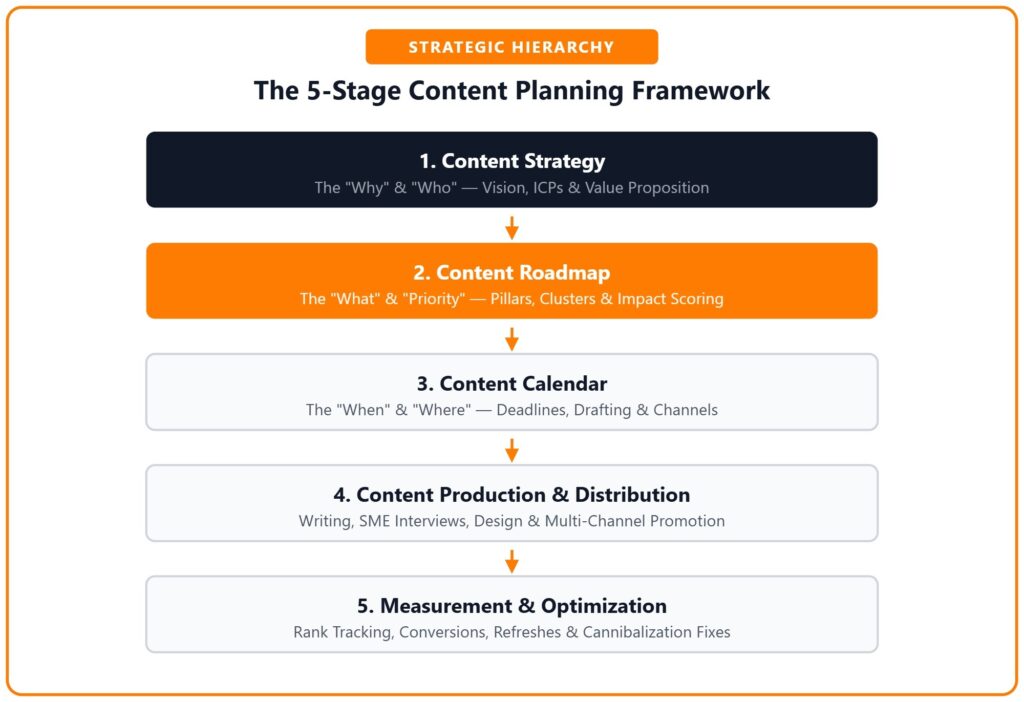
Marketing teams frequently conflate strategy, roadmaps, and calendars. While they are interdependent, each serves a distinct planning layer:
- Content Strategy = The “Why” and “Who” (Goals, audience research, competitive positioning, value proposition).
- Content Roadmap = The “What” and “Priority” (Themes, cluster architecture, specific topics, operational prioritization).
- Content Calendar = The “When” and “Where” (Specific publication dates, publishing channels, social distribution schedules).
| Factor | Content Strategy | Content Roadmap | Content Calendar |
| Main Purpose | Define business vision and market positioning | Organize and prioritize content initiatives | Schedule production and publication dates |
| Primary Focus | Audience, brand voice, messaging, objectives | Topic clusters, search intent, impact vs. effort | Daily publishing tasks, channels, deadlines |
| Timeframe | 1 to 3 Years | 3 to 12 Months | 2 to 6 Weeks |
| Level of Detail | High-level framework | Mid-level thematic planning | Granular task management |
| Core Question Answered | “Why are we creating content and for whom?” | “What projects drive the highest business impact?” | “When and where does each piece get published?” |
Content Planning Framework
How to Create a Content Roadmap in 7 Steps
Building a successful content roadmap for SEO and inbound marketing requires systematic execution across seven distinct phases:
- Define Your Content Goals: Align editorial priorities directly with commercial targets.
- Identify Your Target Audience & Journey: Map persona pain points and search behavior.
- Audit Your Existing Content Assets: Categorize top performers, decay pages, and consolidation opportunities.
- Build Content Pillars & Topic Clusters: Establish structured hub-and-spoke topical authority.
- Map Keywords & Analyze Search Intent: Conduct intent-driven keyword research.
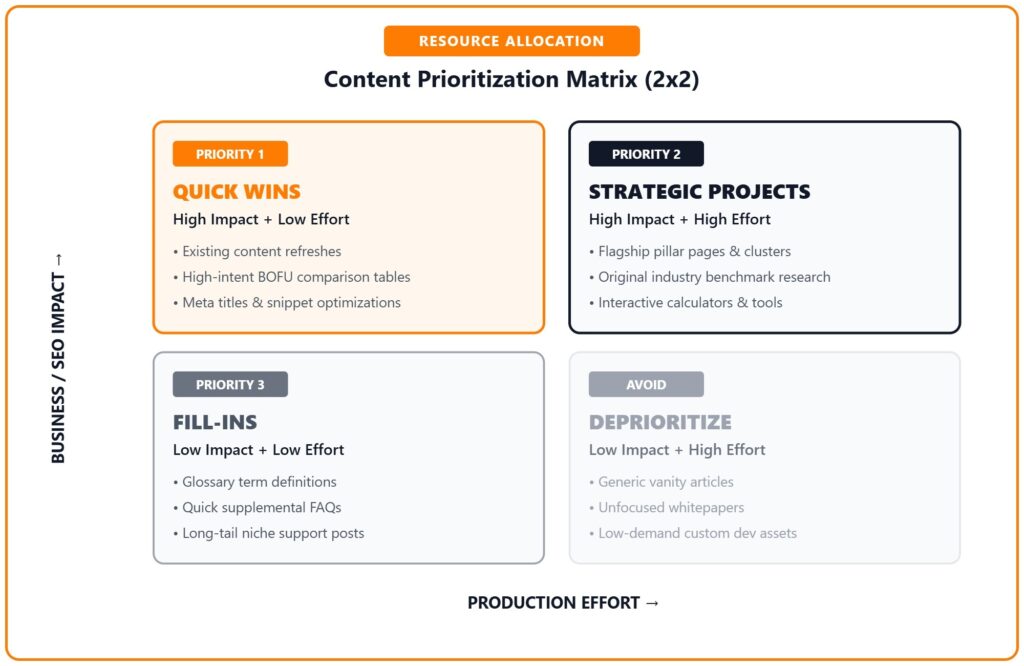
- Prioritize Content Initiatives: Evaluate topics using the Impact vs. Effort matrix.
- Assign Owners, Operational Timelines & KPIs: Enforce production accountability and clear metrics.
1. Define Your Content Goals
Every roadmap item must trace directly to a measurable company metric. Clarify your primary content goals across four categories:
- Business Objectives: Customer acquisition, ARR growth, pipeline acceleration, or churn reduction.
- SEO Objectives: Increasing non-branded organic impressions, securing top rankings for high-intent head terms, and winning AI search overview citations.
- Lead Generation Objectives: Inbound demo requests, free trial activations, and whitepaper downloads.
- Conversion Objectives: Product sign-ups and revenue generated from product-led comparison pages.
2. Identify Your Target Audience
Segment your audience by buyer personas and Ideal Customer Profiles (ICPs). For each segment, map:
- Core Pain Points: Specific operational problems they must solve.
- Search Behavior: How they phrase their queries across search engines and AI assistants.
- Questions Asked: Queries posed to sales reps, support tickets, and community forums.
- Buying Journey: The progression from recognizing an operational problem to evaluating competitive software.
3. Audit Your Existing Content
Before planning new assets, perform a thorough content audit to evaluate your existing library. Categorize pages into four actionable buckets:
- Top-Performing Assets: Pages that generate high rankings and conversions. Identify opportunities to expand and add internal links.
- Underperforming Content: Articles with impressions but low click-through rates (CTRs) or declining positions. Schedule these for on-page optimization.
- Outdated Content: Assets containing obsolete workflows, outdated statistics, or broken screenshots that require factual updates.
- Consolidation Candidates: Multiple thin posts addressing the same search intent (keyword cannibalization) that should be merged into a single authoritative pillar.
4. Build Content Pillars and Topic Clusters
Structure your planned content using a hub-and-spoke model. Build a comprehensive topical content map that connects:
- Content Pillars: Broad, comprehensive overview guides that cover an entire thematic category.
- Supporting Cluster Topics: In-depth articles answering specific sub-queries, long-tail variations, and technical workflows.
- Internal Linking Architecture: Strategic links flowing from supporting sub-topics back to the central pillar and laterally between related cluster nodes to establish deep domain relevance. For practical structuring techniques, refer to our detailed guide on how to build topic clusters.
5. Map Keywords and Search Intent
Conduct keyword research tailored to your industry to assign dedicated queries to every page. Follow an intentional B2B keyword research strategy to prevent keyword duplication:
- Primary Keyword: One target search term that matches the core topic.
- Secondary Keywords: 3 to 6 semantic variations, LSI phrases, and related sub-questions.
- Search Intent Analysis: Analyze live search engine result pages (SERPs) to determine whether search engines favor step-by-step guides, calculators, comparison tables, or video walkthroughs.
- Keyword-to-Page Mapping: Ensure each primary keyword is targeted by exactly one dedicated URL to avoid cannibalization.
6. Prioritize Content Initiatives
Score your proposed topics systematically rather than relying on gut feelings. Evaluate each candidate across:
- Business Impact: Commercial intent, relevance to product features, and lead-generation potential.
- Search Opportunity: Monthly search volume, search trend velocity, and topic longevity.
- Ranking Opportunity: Difficulty of the current SERP and your site’s domain authority.
- Production Effort: SME interview requirements, graphic design needs, custom development, and writing bandwidth.
7. Assign Owners, Timelines, and KPIs
Before drafting begins, prepare a comprehensive content brief for every prioritized topic and assign operational accountability:
- Content Owner: The lead writer, editor, or strategist responsible for delivering the piece.
- Production Milestones: Target dates for brief approval, first draft, editorial review, and live publishing.
- Status Updates: Clear pipeline markers (e.g., Backlog, In Writing, Review, Live).
- Distribution Plan: Primary delivery channel (blog, newsletter, resource center) and promotional channels.
- Success Metric & Review Date: Target metric (e.g., MQLs, non-branded clicks) and an operational audit scheduled 90 to 180 days post-launch. For writing standards, apply proven SEO content creation best practices.
Content Roadmap Example
Below is a realistic 6-topic roadmap designed for a B2B SaaS company specializing in project management software:
| Priority | Topic / Working Title | Primary Keyword | Search Intent | Format | Funnel Stage | Primary KPI |
| Tier 1 (High) | Best Project Management Software for Remote Teams | best project management software | Commercial | Software Buyer Guide | BOFU | Trial Sign-ups |
| Tier 1 (High) | Project Management Software A vs Software B: Full Comparison | project management software comparison | Commercial | Product Comparison Page | BOFU | Demo Requests |
| Tier 2 (Med) | How to Manage Async Remote Team Sprints | async sprint management | Informational | Step-by-Step Guide | MOFU | Newsletter Leads |
| Tier 2 (Med) | Complete Guide to Agile Project Planning | agile project planning guide | Informational | Pillar Guide | TOFU | Organic Traffic |
| Tier 3 (Low) | What Is a Sprint Retrospective? | what is a sprint retrospective | Informational | Glossary Article | TOFU | Impressions |
| Tier 1 (High) | Enterprise Workflow Automation Case Study | workflow automation case study | Transactional | Customer Story | BOFU | Direct Pipeline |
Strategic Rationale
This example prioritizes bottom-of-funnel (BOFU) comparison and buyer guides in Tier 1 because they target prospects with active purchase intent, delivering immediate trial sign-ups and demo pipeline. High-effort pillar pages (Tier 2) build topical authority and sustainable organic traffic over the medium term, while short glossary definitions (Tier 3) provide supporting cluster context without diverting resources from high-converting initiatives. For more on structuring SaaS-specific initiatives, see our SaaS content marketing strategy guide.
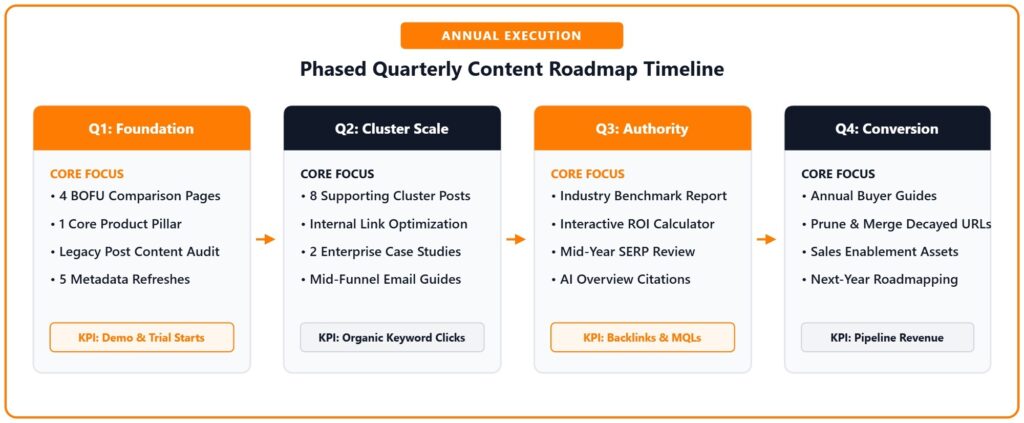
Quarterly Content Roadmap
Content Roadmap Template
Use this comprehensive field guide to configure your spreadsheet, database, or project board:
| Field | Example Value | Description |
| 1. Goal | Pipeline & Trial Sign-ups | The targeted business outcome. |
| 2. Audience | VP of Marketing / IT Directors | Target persona or Ideal Customer Profile. |
| 3. Content Pillar | Enterprise Workflow Management | Parent thematic category. |
| 4. Topic Title | Guide to Enterprise Workflow Automation | Working title for the piece. |
| 5. Primary Keyword | enterprise workflow automation | Main search query to optimize for. |
| 6. Secondary Keywords | workflow tools, automate team tasks | Supporting semantic queries. |
| 7. Search Intent | Informational / Commercial | User intent behind the query. |
| 8. Format | Comprehensive Pillar Guide | Article or asset format. |
| 9. Funnel Stage | Middle-of-Funnel (MOFU) | Buyer journey stage. |
| 10. Priority | Tier 1 (High) | Strategic production priority. |
| 11. Owner | Senior Content Strategist | Person responsible for delivery. |
| 12. Target Date | End of Q1 | Expected publish date. |
| 13. Status | In Drafting | Current editorial stage. |
| 14. Primary KPI | Inbound Lead Submissions | Primary metric for success. |
| 15. Live URL | https://example.com/blog/workflow-guide | Published canonical URL. |
| 16. Review Date | 90 Days Post-Publish | Scheduled performance audit. |
How to Measure a Content Roadmap
A content roadmap should be evaluated against four distinct performance tiers. Align each asset with its designated metric rather than applying a blanket standard across all content types:
| Category | Core Metrics Tracked |
| 1. SEO KPIs | Organic clicks, search impressions, keyword rankings, organic CTR, and total indexed cluster URLs. |
| 2. Engagement KPIs | Average engagement time, returning visitor rate, scroll depth, and in-content click-through rates. |
| 3. Business KPIs | Inbound leads (MQLs), trial sign-ups, demo requests, direct conversions, and assisted revenue. |
| 4. Operations KPIs | Monthly publishing velocity, deadline completion rate, editorial error rate, and content refresh rate. |
Match KPIs to Content Purpose
- Top-of-Funnel (TOFU) educational content must be measured by impressions, organic clicks, and brand discovery, not immediate demo requests.
- Bottom-of-Funnel (BOFU) comparison pages must be measured by free trial starts, demo bookings, and pipeline velocity, even if absolute search volume is modest. For funnel-specific SEO mapping, see our guide on the SEO funnel.
Common Content Roadmap Mistakes
Avoid these eight frequent pitfalls when building and executing your content planning roadmap:
| Mistake | Practical Solution |
| 1. Disconnected Production | Tie every roadmap item to an approved ICP pain point and a measurable business revenue metric. |
| 2. Treating Roadmap as a Calendar | Focus the roadmap on strategic priorities and cluster goals; manage granular daily dates in an editorial calendar. |
| 3. Ignoring Search Intent | Analyze live search engine result pages before writing to match exact format requirements. |
| 4. Overlapping Keyword Cannibalism | Assign one unique primary keyword per URL; merge duplicate posts addressing the same search intent. |
| 5. Prioritizing Volume Over Quality | Publish comprehensive, well-researched cluster assets instead of shallow, unoptimized blog posts. |
| 6. Overcommitting Production Capacity | Calculate realistic team writing bandwidth before locking in quarterly milestones. |
| 7. Neglecting Performance Reviews | Schedule mandatory 90-day post-publish performance check-ins directly inside the roadmap sheet. |
| 8. Static Planning Without Updates | Treat the roadmap as a living document; adjust quarterly based on ranking data and business changes. |
How Often Should You Update a Content Roadmap?
A content roadmap is a living document that must adapt to real-world performance feedback, search algorithm shifts, and changing business priorities. Follow this cadence to keep your roadmap actionable:
| Cadence | Core Review Objectives |
| Monthly Reviews | Check production velocity, clear bottlenecked drafts, audit indexation for newly published pages, and reassign author workloads based on active bandwidth. |
| Quarterly Reviews | Review macro SEO KPIs (organic clicks, top 10 rankings, assisted pipeline), reprioritize backlog items using the Impact vs. Effort matrix, and integrate new product feature launches. |
| Annual Audits | Conduct a site-wide content audit, identify legacy pages requiring consolidation or refreshes, and realign content pillars with next-year company revenue targets. |
Frequently Asked Questions About Content Roadmaps
What is a content roadmap in marketing?
A content roadmap in marketing is a strategic blueprint that organizes, prioritizes, and tracks content marketing initiatives across specific time horizons. It connects brand and revenue objectives with tactical topic production, keyword targeting, audience segments, and measurable KPIs.
What is the difference between a content roadmap and a content calendar?
A content roadmap determines what content initiatives are produced and their strategic priority over a 3-to-12-month horizon based on business impact. A content calendar determines when, where, and how individual assets are drafted, reviewed, and published on a day-to-day, weekly schedule.
What should a content roadmap include?
A functional content roadmap includes the target business goal, audience persona, content pillar, working topic, primary and secondary keywords, search intent, content format, funnel stage (TOFU/MOFU/BOFU), priority score, content owner, production timeline, primary KPI, operational status, and post-publish review date.
How do you create a content roadmap?
To create a content roadmap, first define your business and SEO goals. Next, identify target audience segments and run a content audit. Organize core themes into topic clusters, map keywords to search intent, prioritize initiatives using an Impact vs. Effort matrix, and assign project owners, delivery timelines, and performance KPIs.
How long should a content roadmap be?
A standard content roadmap covers a 3 to 12-month planning horizon, typically organized by operational quarters (Q1 through Q4). Planning beyond 12 months often leads to obsolete assumptions, while planning for fewer than 3 months lacks sufficient strategic continuity for SEO growth.
What tools can you use to create a content roadmap?
Teams can build functional content roadmaps using spreadsheet applications (Google Sheets, Microsoft Excel), collaborative database tools (Notion, Airtable), or enterprise project management software (Asana, Monday.com, Jira, ClickUp).
How do you measure a content roadmap?
Measure content roadmap success across four categories: SEO performance (rankings, organic clicks, impressions), Audience engagement (time on page, scroll depth), Commercial impact (leads, demo bookings, revenue generated), and Operational efficiency (publishing velocity, deadline completion rate).
Final Takeaway
A successful content roadmap is not just an editorial wishlist—it is a structured business asset that aligns strategic intent with practical day-to-day execution:
Business Goals → Audience Needs → Content Pillars → Prioritized Topics → Execution → Measurement → Optimization
Rather than increasing publishing volume arbitrarily, build a prioritized roadmap that balances immediate quick-win conversion assets with long-term topical cluster authority. Treat your roadmap as an evolving framework: audit performance every quarter, refresh decaying content systematically, and ensure every published page drives verifiable value for your business.