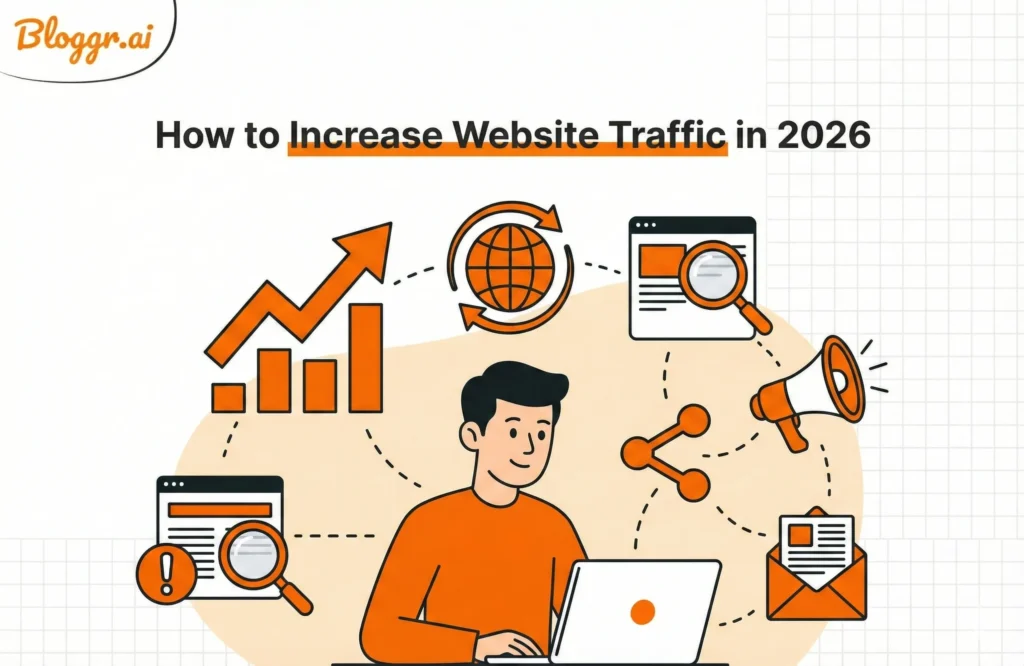
How to Increase Website Traffic in 2026
TL;DR
- AI search engines (ChatGPT Search, Perplexity, Google SGE) are changing how pages get traffic.
- Helpful, people-first content will outperform keyword-stuffed articles.
- Core Web Vitals, UX, and page speed still matter more than ever.
- Build topical authority, optimize for AI Overviews, and expand into multi-channel traffic.
- Use AI tools for research, content planning, personalization, and insights—but not to replace strategy.
Introduction
Website traffic strategies have undergone dramatic shifts in 2025—and in 2026, those changes accelerate.
AI-powered search engines, generative overviews replacing traditional SERPs, and multimodal search are transforming how users discover content. Ranking on Google alone is no longer enough; creators and businesses must diversify their content, improve UX, adopt AI in workflows, and build stronger brand authority. Tools like an AI Blog Writer, which streamline outlining, drafting, and optimizing content, are becoming standard in modern content operations.
This guide breaks down the key strategies you need to increase website traffic in 2026, based on industry trends, algorithm updates, and evolving user behavior.
How Website Traffic Growth Will Evolve in 2026
Below are the three most important shifts shaping traffic growth in 2026.
1. AI Search Engines & Generative Overviews Are Reshaping Traffic
AI search tools don’t just list links—they summarize, aggregate, and rewrite.
To get visibility in these environments, content must:
- Be structured for AI extraction
- Show expertise, credibility & freshness
- Include concise “AI-ready” summaries
- Use semantic keywords
- Cover complete topical scopes
If your content isn’t AI-readable, your traffic will decline even if your Google rankings remain stable.
2. Higher Emphasis on Helpful, People-First Content
Google’s 2025 updates continue rewarding:
- First-hand experience
- Data-backed analysis
- Unique insights
- Real-world examples
- Deep topical coverage
Shallow SEO content is now filtered out or ignored by AI engines.
3. UX, Page Experience & Core Web Vitals Shift
In 2026, Google weighs:
- Interaction to Next Paint (INP)
- Viewport responsiveness
- Asset optimization
- Smooth rendering & low layout shift
A faster, frictionless experience will directly influence rankings and AI visibility.
Pillar 1 — Modern Content Strategy to Attract More Traffic
Build Topical Authority with Pillar + Cluster Content
Topical authority remains the strongest driver of organic traffic.
Strategy:
- Identify core pillars (e.g., “website traffic,” “SEO tools,” “digital marketing”).
- Build 10–20 supporting cluster articles per pillar.
- Interlink everything smartly.
Search engines prioritize websites that own a topic completely, not partially.
Optimize Content for AI Overviews (SGE)
AI summaries select content that is:
- Direct
- Structured
- Factually precise
- Rich in short answers and bullet points
You must include:
- Key takeaways
- Definitions
- Step-based explanations
- Statistics
- FAQ sections
These formats feed AI engines perfectly.
Scale Content with Programmatic SEO (But Safely)
Programmatic SEO is powerful but risky. In 2026 the right way to do it is:
- Human-edited templates
- High-value intent keywords
- Fresh data inputs
- Strict deduplication
- Pattern-based structure
- AI fact validation
Correctly executed, programmatic SEO can drive 100,000+ monthly visits with long-tail scalability.
Refresh Old Content for High-ROI Traffic
Content updating now outperforms new blog publishing.
Update checklist:
- Add better insights
- Replace outdated stats
- Improve clarity
- Add FAQs
- Upgrade visuals
- Strengthen UX
- Change title + meta if needed
Refreshing is the fastest way to gain traffic in 2026.
Create Multi-Format Content
AI search engines favor content sources that offer multiple formats:
- Articles
- Carousels
- Videos
- Infographics
- Interactive tools
- Data tables
Multi-format content boosts:
- Engagement
- Shares
- Crawl value
- Backlinks
- AI extraction accuracy
Modern content creation tools, including AI-assisted blog writers like BloggrAI, make it easier to produce structured, high-quality posts that align with these formats and perform better across both SERPs and AI-driven search engines.
Pillar 2 — Technical SEO & Website Performance
Core Web Vitals Optimization Checklist
Key metrics for 2026:
- INP < 200ms
- CLS < 0.1
- LCP < 2.5s
- Fast server response times
- Defer non-critical scripts
Technical excellence = better rankings + better AI visibility.
Mobile-First UX
80% of web traffic is mobile.
Prioritize:
- Speed
- Readability
- Tap-friendly elements
- Vertical navigation
- Mobile-first layout hierarchy
Crawlability & Index Control
Avoid index bloat by:
- Removing thin pages
- Using crawl directives correctly
- Keeping a clean sitemap
- Consolidating duplicate content
AI engines prefer clean, authoritative sites.
Schema Markup for Higher Visibility
Schema helps AI engines understand:
- People
- Reviews
- FAQs
- Articles
- Locations
- Products
- How-to steps
- Pricing
Rich markup is essential for AI search inclusion.
Privacy, Security & Analytics Evolution
With cookieless tracking:
- Server-side analytics
- First-party tracking
- Event-based measurement
- Consent-based personalization
are becoming the new standard.
Pillar 3 — Multi-Channel Traffic Generation (Not Just Google)
Social Media for Website Traffic
2026 priorities:
- Short-form video distribution
- Thought-leadership text posts
- Data-driven carousels
- Pinterest SEO
- LinkedIn rankings
- High-save-value posts
AI Search & Aggregators
Traffic now comes from:
- ChatGPT Search
- Google SGE
- Perplexity
- Anthropic
- Meta AI
- Kaggle + data aggregators
Optimizing for these platforms requires structured, precise, fact-rich content.
Email as a Primary Traffic Engine
Email is becoming the most stable traffic source.
Strategies:
- Weekly newsletters
- Deep-dive tutorials
- Lead magnets
- Personalized content segmentation
Communities, Forums & Micro-Platforms
Traffic sources include:
- Slack groups
- Discord channels
- Substack comments
- ProductHunt
- Niche communities
These generate highly engaged, conversion-ready users.
Paid Distribution for Smart Amplification
Paid promotion supports organic growth:
- Boost high-performing posts
- Promote lead magnets
- Launch retargeting funnels
- Highlight pillar content
Paid + organic = stable traffic compounding.
Pillar 4 — Authority & Link-Building in 2026
Digital PR for High-Authority Backlinks
Modern digital PR includes:
- Data-driven studies
- Visual research reports
- Industry predictions
- Controversial opinions
- Founder-led storytelling
These naturally generate high-authority links.
Linkable Assets That Still Work
Proven formats:
- Statistics pages
- Industry reports
- Calculators/tools
- Templates
- Checklists
- Case studies
- Infographics
Guest Posting, Collaborations & Partnerships
Still effective when:
- Niche relevant
- High editorial quality
- Anchor text natural
- Value-driven content
Referral Traffic Strategies
Use:
- Co-marketing
- Cross-promotion
- Podcast guesting
- Roundup contributions
These drive traffic outside dependency on Google.
Pillar 5 — Analytics, Measurement & AI Tools
KPI Framework for 2026
Track:
- Organic traffic
- AI search impressions
- Email traffic
- Engagement metrics
- Conversion rate
- Content depth score
- Topical authority score
Cookieless Attribution Challenges
To navigate this:
- Use server-side analytics
- Rely on predictive AI models
- Combine data sources
- Track event-based funnels
Using AI for SEO, Not to Replace SEO
AI helps:
- Outline research
- Competitor analysis
- Keyword extraction
- Content brief generation
- SERP gap identification
But human expertise is required for real authority.
Experimentation & CRO
Traffic is useless without conversions.
Focus on:
- A/B testing
- Personalization
- Smart CTAs
- Social proof
- UX optimization
- Page-specific CRO tests
Local & Niche Traffic Growth Strategies
Local SEO Essentials
To dominate local markets:
- Optimize Google Business Profile
- Publish location-based landing pages
- Collect and respond to reviews
- Add local schema
- Build local backlinks
Conducting a regular local SEO audit also helps identify gaps in visibility, technical issues, and opportunities to improve local rankings.
Voice Search & Conversational Queries
With AI-powered assistants rising:
- Write in natural language
- Add Q&A formats
- Use conversational long-tail keywords
- Include short, direct answers
Voice search optimisation increases visibility across AI engines.
Conclusion
Driving website traffic in 2026 is not about chasing algorithms—it’s about aligning with how people search, consume, and trust information today.
By building topical authority, optimising for AI search, improving technical foundations, distributing content across channels, and leveraging AI-powered insights, you will increase your website’s visibility and attract high-quality, sustainable traffic.
The brands that win in 2026 are those that combine helpful content, excellent UX, strong authority, and strategic multi-channel presence—consistently.
“By signing up for BloggrAI for free, you can generate structured blog content designed to rank higher in SERPs and AI search engines, helping attract more traffic.”
FAQs on How to Increase Website Traffic
1. What are the 7 C’s of a website?
Ans: The 7 C’s of a website are Context, Content, Community, Customization, Communication, Connection, and Commerce. Together, they ensure a site is user-friendly, engaging, and optimized for conversions.
2. What are the 3 C’s of SEO?
Ans: The 3 C’s of SEO are Content, Code, and Credibility. These represent the pillars of ranking: quality information, strong technical SEO, and authoritative backlinks.
3. Why 96.55% of content gets no traffic from Google?
Ans: Most content gets no traffic because it lacks keyword targeting, offers low value, or comes from sites with weak authority. Without strategy and optimization, Google simply doesn’t surface it.
4. What is a good website traffic increase?
Ans: A good traffic increase is typically 10–20% monthly or 30–50% yearly, depending on site maturity. The best growth also improves engagement and conversions, not just visits.