
Comparison Between On Page vs Off Page SEO with Examples
TL;DR
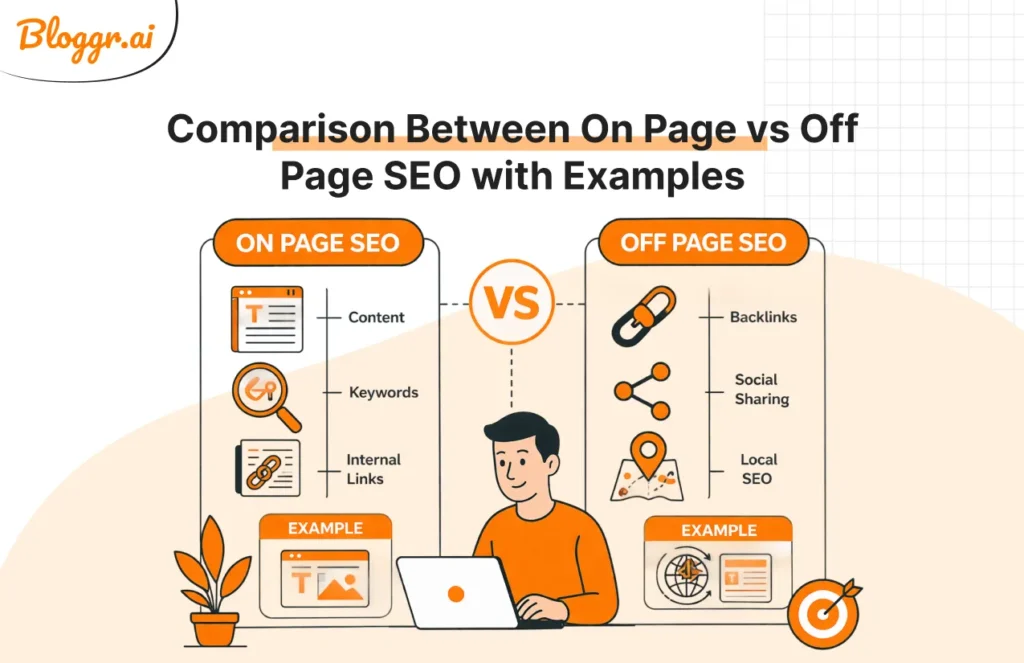
- On Page SEO = Optimizing content, structure, and UX on your website
- Off Page SEO = Building authority through backlinks and external signals
- On Page improves relevance; Off Page builds trust
- You need both to rank in competitive search results
- Start with On Page, then scale with Off Page
Introduction
Over the past few years, working on SEO-driven websites, one pattern has remained consistent:
Websites don’t rank because they “do SEO”, they rank because they balance the right SEO efforts at the right time.
One of the most misunderstood areas is the difference between on-page and off-page SEO.
Many beginners over-focus on backlinks. Others spend months perfecting content without promotion.
In this guide, I’ll break down:
- The real difference between On-Page and Off-Page SEO
- What actually impacts rankings (based on practical observations)
- Examples and strategies that consistently work in real scenarios
What is On-Page SEO? (With Practical Context)
On-page SEO is everything you control directly on your website.
But in practice, it’s not just about adding keywords; it’s about making your content genuinely useful, structured, and easy to understand—something often clarified with the help of an SEO Glossary.
What Actually Matters in On-Page SEO
From experience, these are the elements that move rankings:
- Writing content that directly satisfies search intent
- Structuring content with clear headings using a blog outline generator (not just for SEO, but for readability)
- Using internal links to guide both users and crawlers
- Optimizing page speed to reduce drop-offs
- Ensuring content depth (covering the topic completely, not superficially)
Real Example (On Page Impact)
On one blog, simply:
- Improving content structure
- Adding missing subtopics
- Fixing internal links
…moved a page from position 28 to position 11 without any backlinks.
Insight: On-page SEO, along with proper execution of the content brief, determines whether your content deserves to rank.
What is Off-Page SEO? (From a Practical Lens)
Off-page SEO is about how the rest of the internet perceives your website.
In simple terms:
Why should Google trust your content over others?
What Actually Works in Off-Page SEO
Based on consistent results:
- Getting backlinks from relevant (not just high-DA) websites
- Earning mentions in niche communities
- Publishing content that others naturally reference (for example, insights or content created using an AI Blog Writer)
- Building topical authority over time
Real Example (Off-Page Impact)
After improving the content (on-page), the page was stuck on page 2.
Then:
- 5–7 quality backlinks were acquired from niche blogs
Result: Page moved to the top 5 positions within weeks
Insight: Off-page SEO determines whether your content wins rankings.
On Page vs Off Page SEO: The Real Difference
| Aspect | On Page SEO | Off Page SEO |
| What it controls | Content & structure | External trust signals |
| Purpose | Relevance | Authority |
| Dependency | Fully controllable | Depends on others |
| Impact | Makes content rankable | Makes content competitive |
If you want to know compersion on:
Blog vs Vlog
How On-Page and Off-Page SEO Work Together
Think of SEO like this:
- On Page SEO = Foundation
Without proper content and structure, nothing else works. - Off Page SEO = Authority Boost
Helps your content compete and rank higher.
Even strong backlinks won’t help if your page fails to satisfy user intent, and even high-quality content needs authority SEO to compete in competitive niches.
Which One Should You Focus On First?
Based on real-world SEO execution:
- New Websites
Focus on on-page SEO first. Build strong content and structure, and optimize your snippets with a meta description generator to drive early clicks. - Growing Websites
Start investing in Off Page SEO (backlinks, outreach). - Competitive Niches
You need a balanced strategy from day one.
Common Mistakes to Avoid (From Real SEO Experience)
- Writing content without checking what’s already ranking
A lot of people jump straight into writing, but if your content doesn’t align with SEO ranking factors and match what Google is already rewarding (blogs, listicles, guides), it simply won’t rank—no matter how “good” it is. - Over-optimizing instead of writing naturally
I’ve seen pages where the keyword is forced into every heading. It doesn’t help; it actually makes the content worse for users and often hurts rankings. - Chasing backlinks without fixing the page first
Building links to a weak page is like pouring water into a leaking bucket. If your content isn’t strong, backlinks won’t save it. - Ignoring internal linking completely
This is one of the easiest wins, yet most sites miss it. Proper internal linking alone can improve rankings without any new backlinks. - Going for cheap or irrelevant backlinks
Not all links are equal. A single relevant link can outperform dozens of random directory or spam links. - Expecting Off-Page SEO to work instantly
Many people give up too early. Authority takes time to build; it’s not a quick win like on-page changes.
Conclusion
The comparison between On Page vs Off Page SEO isn’t about choosing one; it’s about understanding how they complement each other.
- On-page SEO ensures your content is relevant and user-friendly
- Off-page SEO builds the authority needed to rank
If you focus on both strategically, you create a strong foundation for long-term SEO growth. (Tip: When wrapping up your own articles, use a conclusion generator to craft actionable summaries that reinforce your key points.)
FAQs
Q. What is the main difference between On-Page and off-page SEO?
On-page SEO focuses on optimizing your website content and structure, while off-page SEO focuses on building authority through external signals like backlinks.
Q. Which is more important, on-page or off-page SEO?
Both are essential. On-page builds the foundation, while off-page helps you compete and rank higher.
Q. Can I rank with only On Page SEO?
Yes, but mostly for low-competition keywords. For competitive terms, off-page SEO is necessary.
Q. How long does Off-Page SEO take to show results?
Typically, it takes a few weeks to several months, depending on competition and backlink quality.
Q. Is link building still important in SEO?
Yes, backlinks remain one of the strongest ranking signals when they are high-quality and relevant.